
Why Does My Pillow Get Hot? (And How to Fix It)
Your head radiates heat all night, and a pillow's job description unfortunately includes wrapping itself around that heat source. Whether the pillow warms up fast, a little, or barely at all depends on four things working together: what the fill is made of, what the case and protector are made of, how deep your head sinks, and how warm the room is. The fix is usually cheaper than a new pillow.
In this guide
The physics in one paragraph
A pillow warms up when heat arrives faster than it can leave. Your head supplies heat continuously; the fill either stores it (dense, closed materials like memory foam) or passes it through (open, airy materials like buckwheat and latex). Everything layered over the fill — protector, pillowcase — either preserves that airflow or seals it off.
Suspect one: the fill
Solid memory foam is the most common culprit. It is dense, it softens by absorbing your body heat — heat retention is built into how the material works — and its closed structure gives warmth no exit path. Solid polyester and cheap microfiber behave similarly.
If your pillow is solid foam and runs hot, the fill is the bottleneck and no case change will fully fix it. Shredded foam, ventilated latex, buckwheat, or a grid-structure pillow are the upgrades, in increasing order of airflow.
Suspect two: the case and protector
This is the most overlooked layer and the cheapest to change. A waterproof vinyl or thick polyurethane protector is essentially a plastic bag around your pillow: it seals the fill's airflow completely. Heavy sateen and flannel cases trap heat almost as effectively.
The fix: a breathable protector (look for membrane-free or knit waterproofing) and a percale cotton, linen, or performance-knit pillowcase. Owners are regularly surprised how much cooler the same pillow sleeps after this one change.
Suspects three and four: sink depth and room temperature
The deeper your head sinks, the more pillow surface wraps around it and the more heat is trapped against your skin. Very soft, low-loft pillows are the worst offenders — which is why going plusher is rarely the cooling fix people expect it to be.
Finally, the room. No pillow cools below the temperature of the air around it; it can only approach room temperature faster. A bedroom above roughly 68°F limits every pillow's cooling ability. Cooling the room, or moving air across the bed with a fan, multiplies whatever your pillow can do.
Pillows we recommend for this
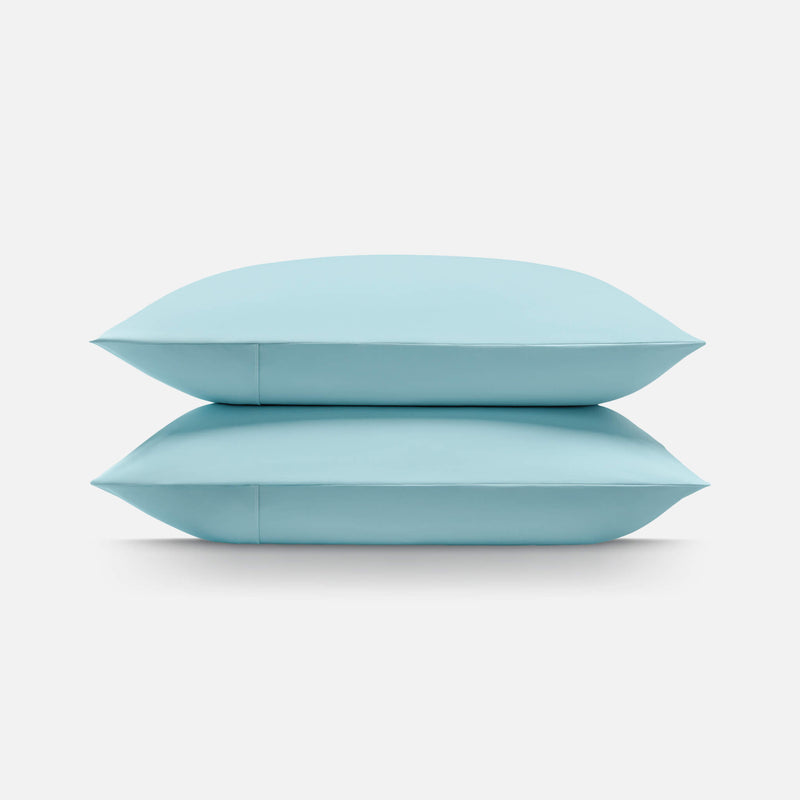
Rest Evercool+ Cooling Pillowcases
Hot sleepers and night sweaters who want instant cool-to-the-touch fabric
FAQ
Keep reading
Get the Mr. Squish Pillow Cheat Sheet
A simple guide to choosing the right pillow based on your sleep position, body size, and comfort preferences.
No spam. Unsubscribe anytime.
Affiliate disclosure: Mr. Squish may earn a commission when you buy through links on this page. Recommendations are based on independent product research; any hands-on test is labelled separately. Learn more.