
Where to Put a Pillow for Lower Back Pain
Lower back pain at night almost always comes down to the same mechanics: some part of your spine is being pulled out of its neutral curve for hours at a time. The fix usually isn't a new mattress — it's a pillow placed in the right spot to prop your hips, knees, or pelvis back into alignment. The catch is that 'the right spot' is completely different depending on how you sleep. Here's exactly where to put a pillow for lower back pain in every position, plus what to do when placement alone isn't enough.
In this guide
The short answer
Side sleepers: pillow BETWEEN your knees and lower shins, with your knees bent. Back sleepers: pillow UNDER your knees. Stomach sleepers: thin pillow under your HIPS and lower abdomen — and consider transitioning off stomach sleeping, since it's the hardest position on your lower back. Each placement stops a different kind of spinal strain, which we'll break down below.
Side sleepers: between the knees
When you lie on your side, your top leg slides forward and down, rotating your pelvis and twisting your lumbar spine all night. That's the rotation that produces the classic 'stiff when I wake up, fine by noon' lower back ache.
The fix: bend your knees to roughly 45–90 degrees and place a pillow between them so it fills the gap from knees to lower shins. Both knees AND ankles should be supported — a pillow only under the knees lets the ankles drag the legs out of line. This keeps your hips stacked vertically and your lumbar spine neutral.
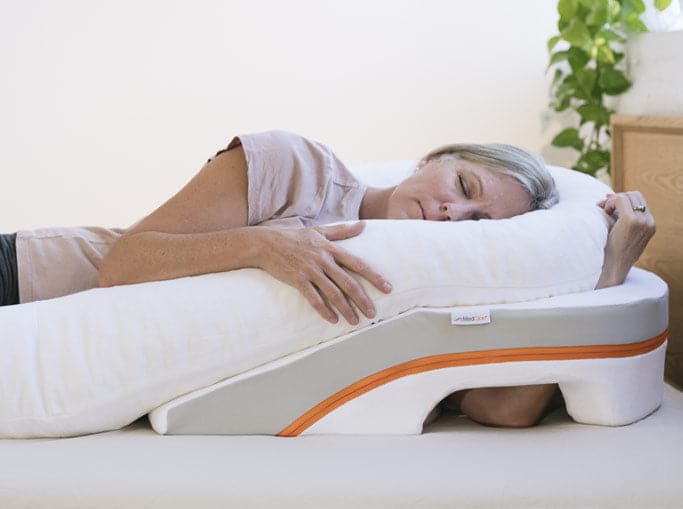
Pillow choice: a firm, thick standard pillow works; a contoured knee pillow stays put better if you toss. A body pillow is the deluxe version — it supports your knee and your top arm at once. Our knee pillow guide goes deep on shapes and placement.
Back sleepers: under the knees
Back sleeping is generally the best position for lower back pain — but lying flat with straight legs arches the lower back and loads the lumbar joints. Placing a pillow under your knees bends the hips slightly, flattens the lower back against the mattress, and takes that load off. Most people feel the difference the first night.
Use a pillow with some loft — a flat one does nothing. A wedge pillow under the knees is the upgraded version: it holds its shape all night and elevates the legs more consistently than a squishy pillow that migrates. If your pain is worst in the morning, also check that your head pillow isn't too tall — a cranked-forward neck travels down the whole spine.
Stomach sleepers: under the hips
Stomach sleeping is the toughest position on the lower back: your midsection sinks, your spine hyperextends, and your neck rotates to one side for hours. If you can't give it up, slide a THIN pillow under your hips and lower abdomen. This lifts the midsection, flattens the hyperextended curve, and takes pressure off the lumbar joints.
Pair it with a very flat head pillow (or none) so your neck isn't cranked upward. Longer term, the best move is transitioning toward side sleeping — a body pillow hugged in front of you scratches the same 'pressure on the front' itch that makes stomach sleeping feel secure, while keeping your spine in a much safer position.
Sitting up in bed or reclined
If you sleep reclined because of reflux, congestion, or post-surgery instructions, a wedge pillow under your upper back plus a pillow under your knees is the standard setup — the knee pillow stops you sliding down the slope, which is what otherwise bends the lumbar spine all night. Our wedge pillow guide covers angles and anti-sliding setup in detail.
For reading or working propped up in bed, a backrest pillow with arms keeps you upright without rounding your lower back the way stacked pillows do.
When pillow placement isn't enough
Pillow placement fixes alignment strain — it won't fix pain from a worn-out mattress, an injury, or something medical. See a doctor if pain radiates down your leg, comes with numbness or tingling, wakes you at night consistently, or follows an injury. And if your mattress is over 7–10 years old and sags where your hips rest, no pillow placement can fully compensate.
Pillows we recommend for this
FAQ
Where do you put a pillow for lower back pain when sleeping on your side?
Between your knees and lower shins, with your knees bent. This keeps your hips stacked and stops your top leg rotating your pelvis and twisting your lower back overnight.
Does putting a pillow under your knees help lower back pain?
Yes — for back sleepers it's the single most effective placement. It bends the hips slightly, flattens the lower back against the mattress, and offloads the lumbar joints.
Is it better to sleep on your back or side with lower back pain?
Both can work — back sleeping with a pillow under the knees, or side sleeping with a pillow between the knees. Stomach sleeping is the position to avoid; it hyperextends the lower back.
What kind of pillow is best between the knees?
A firm, thick pillow that supports both knees and ankles. Contoured knee pillows stay in place best for restless sleepers; a body pillow adds top-arm support and prevents rolling.
Keep reading
Find the Right Pillow for Your Sleep Style
Get a tailored shortlist based on sleep position, shoulder fit, desired loft and materials using our free Pillow Finder.
Start the Free Pillow Finder →Instant recommendations, no email or signup required. We may earn commissions on some buying links.
Affiliate disclosure: Mr. Squish may earn a commission when you buy through links on this page. Recommendations are based on independent product research; any hands-on test is labelled separately. Learn more.