
Pillowcase vs Cooling Pillow: Which Matters More for Sleeping Cool?
Hot sleepers face a fork: buy a cooling pillow, or buy a cooling pillowcase for a fraction of the price. The honest answer is that they do different jobs. The case controls what your skin feels; the fill controls what happens over eight hours. Depending on your actual problem, either one can be the right first purchase — here's how to tell which.
In this guide
What a cooling pillowcase can do
The case is the contact layer, and contact is what your skin reads. A percale cotton, linen, or performance-knit case feels cooler to the touch, wicks moisture off the skin, and — critically — preserves whatever airflow the fill underneath has. For a sweaty sleeper, moisture-wicking alone can be transformative, because evaporation is the body's main cooling mechanism.
The case is also the fix when the real problem is the barrier layer: a good breathable pillow sealed inside a vinyl protector sleeps hot, and swapping the protector and case restores it for $30 instead of $150.
What a cooling pillow can do
The fill sets the overnight ceiling. A breathable fill — buckwheat, ventilated latex, grid structures, shredded foam — prevents the heat buildup that no surface fabric can offset. If your pillow is solid memory foam, it will accumulate heat all night regardless of what case you put on it; the case can only affect the interface, not the reservoir.
The pillow is also where loft lives, and loft interacts with heat: a deep-sinking soft pillow wraps more surface around your head. No case fixes a pillow that buries your face.
Decision framework
Start with the case when your current pillow is already a breathable fill, when you sleep on a waterproof protector, when your problem is sweat and dampness rather than a hot surface, or when budget is tight. It is the highest-value first move.
Start with the pillow when the fill is solid memory foam or cheap solid polyester, when you wake hot at 3 a.m. rather than feeling hot at bedtime, or when the pillow has gone flat and now swallows your head. Then pair it with the right case — the two multiply.
- Breathable fill + hot sleep: change the case/protector first
- Solid foam fill + hot sleep: the pillow is the bottleneck
- Sweaty sleeper: moisture-wicking case first, wool or breathable fill second
- Budget move: percale case, ~$20-40. Bigger move: breathable-fill pillow, ~$60-150
The combination that actually works
Owners who report solving night heat almost always describe a system, not a product: a breathable fill, a moisture-wicking or percale case, no sealed protector, and a room cool enough for the pillow to dump heat into. Each layer either passes heat along or blocks it.
The corollary is the common failure: an expensive cooling pillow installed under a plasticized protector and a heavy sateen case, in a warm room. The pillow never had a chance.
Pillows we recommend for this
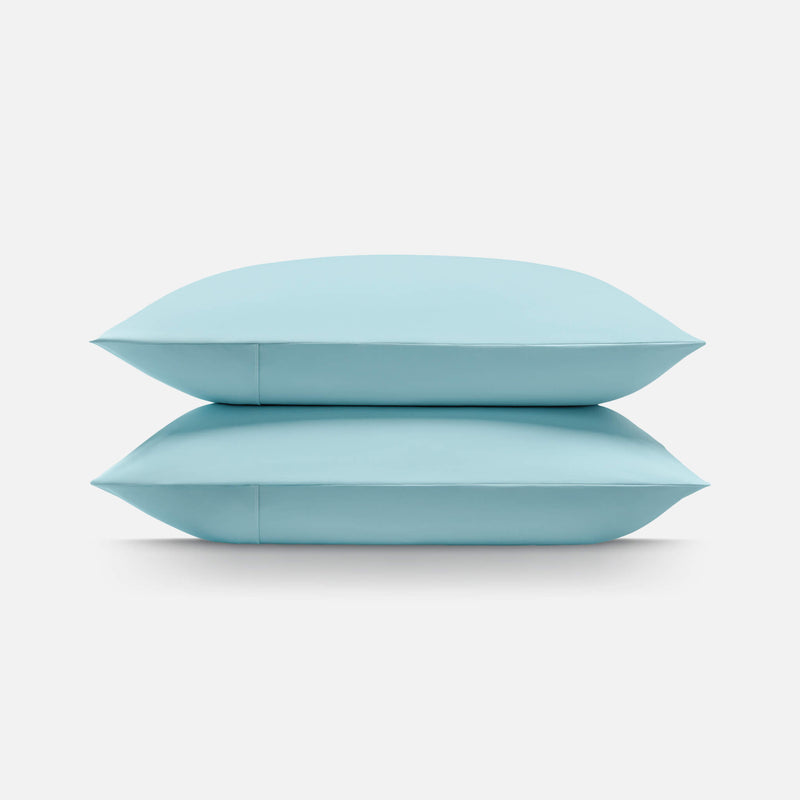
Rest Evercool+ Cooling Pillowcases
Hot sleepers and night sweaters who want instant cool-to-the-touch fabric


FAQ
Keep reading
Get the Mr. Squish Pillow Cheat Sheet
A simple guide to choosing the right pillow based on your sleep position, body size, and comfort preferences.
No spam. Unsubscribe anytime.
Affiliate disclosure: Mr. Squish may earn a commission when you buy through links on this page. Recommendations are based on independent product research; any hands-on test is labelled separately. Learn more.