
The Best Sleeping Position for Lower Back Pain
If you wake up with a stiff, aching lower back that loosens within thirty minutes of moving, your sleep setup is a likely culprit. The lumbar spine has a natural inward curve, and the goal overnight is simple: hold that curve without exaggerating or flattening it. Every position can be made to work, and every position needs a specific pillow arrangement to get there.
In this guide
Side sleeping with a knee pillow — best for most people
For the majority of people with lower back pain, side sleeping with a pillow between the knees is the most reliable setup. It keeps the hips stacked so the pelvis does not rotate, and it prevents the top leg from pulling the lumbar spine into a twist. Add a head pillow tall enough to keep your neck level with your spine — usually 5 to 7 inches of loft for average shoulders — because a too-flat head pillow bends the whole spinal chain.
- Contoured knee pillow, or a body pillow if you want belly support too
- Head pillow loft matched to shoulder width, not to how soft it feels
- Slight bend at the knees, not a tight curl
Back sleeping with knee support — best for spinal alignment
Back sleeping distributes weight most evenly of any position, which makes it excellent in theory. The catch is that lying with your legs flat tilts the pelvis and exaggerates the lumbar curve. A pillow under the knees fixes it in one move, and a thin rolled towel in the small of your back helps people whose mattress leaves a visible gap there.
Keep your head pillow lower than a side sleeper's. Too much head loft pushes the chin toward the chest and flattens the cervical curve, which changes how the rest of the spine sits.
Stomach sleeping — the position to change
Stomach sleeping forces lumbar extension and sustained neck rotation, and it is the position most consistently linked to morning back pain. If you cannot switch overnight, reduce the damage: a thin pillow under the pelvis and lower abdomen to flatten the arch, and the flattest head pillow you own — or none at all. To transition, start on your side hugging a body pillow, which blocks the roll onto your stomach.
The head pillow still matters
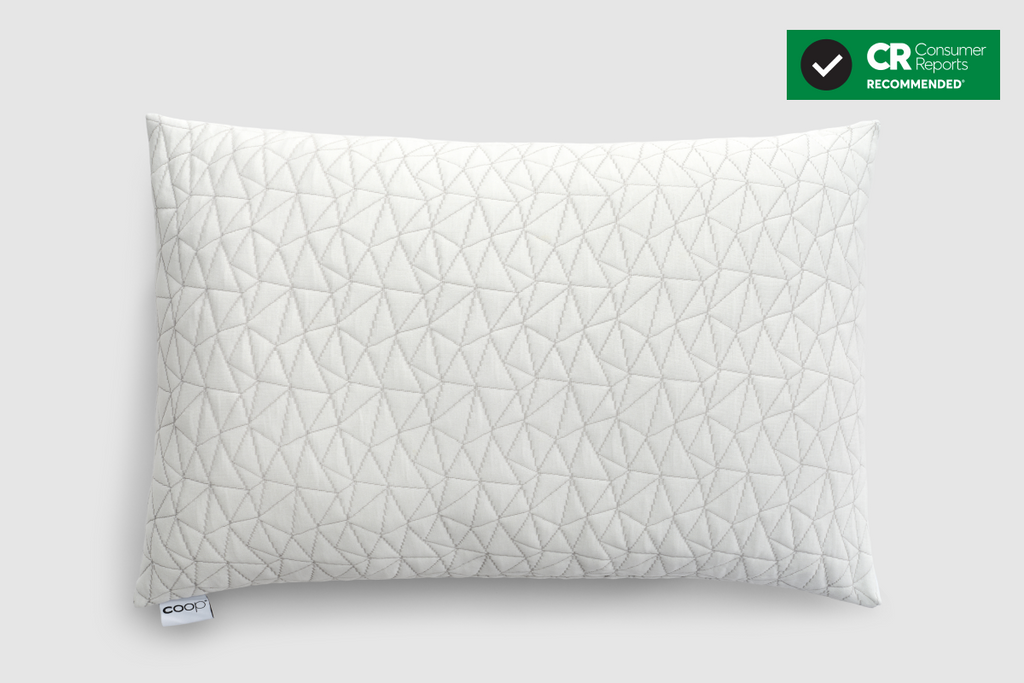
People with back pain often focus entirely on knee and lumbar support and keep whatever old head pillow they have. That is a mistake. A collapsed or wrongly sized head pillow tilts the cervical spine, and the compensations run down the chain into the thoracic and lumbar segments. An adjustable shredded-foam pillow is the easiest way to solve this because you can remove or add fill until your neck sits level, and a cervical contour is a good choice for dedicated back sleepers.
Fixing your mattress before you buy a new one
A mattress that sags in the middle will beat any pillow arrangement. Check it honestly: lie down and have someone look at whether your hips drop below your shoulders. Medium-firm is the range research on chronic low back pain generally supports. If yours is too soft, a firm topper helps in the short term; if it is too firm and your hips and shoulders feel like pressure points, a plush topper lets your body settle into alignment instead of bridging across the surface.
Morning routine
Get out of bed by rolling to your side, letting your legs swing off the edge, and pushing up with your arms — never a straight sit-up from flat. Spend two minutes on gentle movement before loading your spine: knee-to-chest pulls, pelvic tilts, or a slow standing hip hinge. Stiffness that clears in under thirty minutes usually points at setup. Pain that intensifies through the day or radiates into a leg needs a clinician.
Pillows we recommend for this

FAQ
What is the best sleeping position for lower back pain?
Side sleeping with a pillow between the knees works for most people. Back sleeping with a pillow under the knees is equally good for alignment and often better for people with disc-related pain. Both keep the pelvis level and the lumbar curve neutral.
Is sleeping on your stomach bad for your back?
Yes, it is the worst position for lower back pain. It forces the lumbar spine into extension and requires prolonged neck rotation. If you cannot change yet, put a thin pillow under your pelvis and use the flattest head pillow possible.
Should I put a pillow under my back or my knees?
Knees first. For back sleepers, a pillow under the knees flexes the hips and reduces excess lumbar curve — the highest-impact change. A thin rolled towel in the small of the back is a useful addition, not a substitute.
How many pillows do I need for back pain?
Two: one under your head, sized to your sleep position, and one at your knees or under your legs. Most people with back pain only use the first and miss the one that actually controls pelvic alignment.
Why does my lower back hurt when I wake up but feel fine later?
That pattern points at your sleep setup rather than an injury — a sagging mattress, a position that holds the lumbar spine out of neutral, or a missing knee pillow. Fix the alignment and morning stiffness usually improves within a couple of weeks.
Keep reading
Find the Right Pillow for Your Sleep Style
Get a tailored shortlist based on sleep position, shoulder fit, desired loft and materials using our free Pillow Finder.
Start the Free Pillow Finder →Instant recommendations, no email or signup required. We may earn commissions on some buying links.
Affiliate disclosure: Mr. Squish may earn a commission when you buy through links on this page. Recommendations are based on independent product research; any hands-on test is labelled separately. Learn more.