
What Size Wedge Pillow Do I Need?
Almost every complaint about wedge pillows — sliding down all night, a sore lower back, feeling folded in half — comes from buying the wrong height rather than the wrong brand. Wedge height determines the incline angle, and the angle you need depends entirely on why you are elevating in the first place. This guide translates the numbers on the box into what they actually feel like in bed.
In this guide
Height translates to angle, not comfort
Manufacturers list a wedge by its tallest edge in inches. That height, combined with the length of the slope, produces the incline angle. A short, steep wedge and a tall, long wedge can share a height number and feel completely different, so read the length too — a 24-inch-long slope is gentle, a 20-inch slope at the same height is noticeably sharper.
- 7 inches — roughly a 10 degree incline. Gentle. Good for mild snoring, sinus congestion, and anyone new to sleeping inclined.
- 10 inches — roughly a 12 to 15 degree incline. The most common all-purpose height and the usual starting point for acid reflux.
- 12 inches — roughly a 15 to 20 degree incline. Used for stubborn reflux, post-surgery recovery, and breathing conditions when a doctor has recommended significant elevation.
- Under 7 inches — best treated as a leg or knee wedge rather than a torso wedge.
Match the height to the reason you're elevating
Elevation is not a case of more is better. Too much angle compresses the abdomen and pushes you down the slope during the night, which is worse than a modest angle you actually keep all night.
- Acid reflux and GERD — start at 7 to 10 inches. Reflux research generally supports elevating the head of the bed by roughly 6 to 8 inches; a wedge that lifts the whole torso is the practical version of that.
- Snoring — 7 inches is usually enough. The goal is to stop the tongue and soft palate falling back, and that happens at a fairly shallow angle.
- Post-surgery (shoulder, cardiac, some abdominal) — follow the surgeon's instruction first; 10 to 12 inches is the common recommendation but this is medical guidance, not a shopping decision.
- Congestion or a cold — 7 inches, temporarily. You do not need a permanent purchase for a week of sinus pressure.
- Leg elevation for swelling or circulation — 7 to 8 inches, used under the calves rather than the torso.
Width matters more than people expect
Most wedges are 24 to 32 inches wide. A 24-inch wedge is fine if you sleep flat on your back and stay put. If you turn onto your side at any point, a narrow wedge lets your shoulder drop off the edge, and you will wake up half on and half off it.
For side sleepers and anyone who moves, look for at least 30 inches of width, or a full-width bed wedge. If you share the bed and want both sides elevated, a mattress-width wedge or under-mattress riser causes fewer arguments than two separate wedges with a valley between them.
Foam construction and firmness
A wedge that is too soft collapses under the weight of your torso and quietly loses half its angle by morning. Look for a dense polyurethane base — the memory foam layer, if there is one, should sit on top for comfort, not carry the load.
- Solid support foam base with a thin memory foam or gel layer on top is the most reliable construction.
- All-memory-foam wedges feel plush initially and sink over the first hour.
- Inflatable wedges are travel gear; they are not a substitute for nightly use.
- A removable, washable cover is worth the small premium — a wedge is too big to launder and too expensive to replace.
Two-piece and adjustable systems
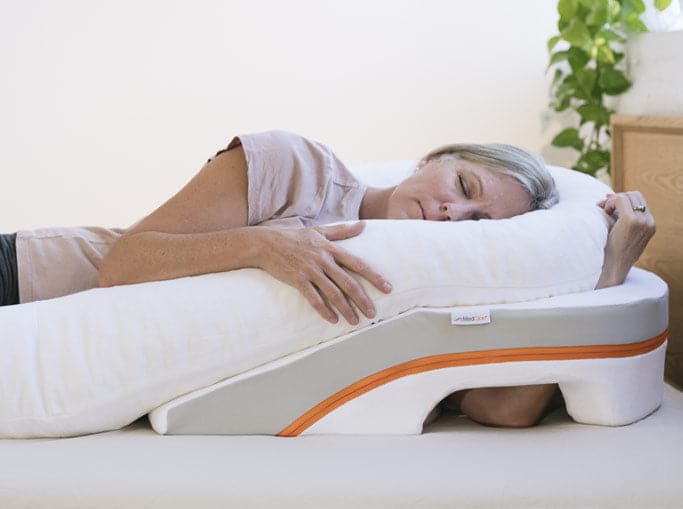
If you are not sure what angle you need, an adjustable or stacking system solves the guessing problem. Two-piece wedges let you use the base alone for a shallow incline or stack both for a steeper one. Full-body systems like the MedCline design go further, adding an arm pocket and body pillow so side sleepers can stay on their left side without sliding — which is the specific failure mode of a plain foam wedge for reflux sufferers.
Stopping the slide
Sliding down a wedge overnight is the number one reason people abandon them. Three fixes work: choose a wedge with a gentler slope than you think you need, add a small pillow or bolster under the knees to create a counter-brace, and use a non-slip cover or place the wedge directly on the sheet rather than on a slick mattress protector. If you still slide, the angle is too steep for you.
How to use it with your regular pillow
Use a thin pillow on top of the wedge, not your usual one. The wedge already provides most of the elevation; adding a full-loft pillow on top bends your neck forward and creates exactly the neck pain the wedge was supposed to prevent. A low-loft or flat pillow, or none at all if the wedge has a contoured head section, is correct.
Pillows we recommend for this
FAQ
What is the most common wedge pillow height?
10 inches. It gives roughly a 12 to 15 degree incline, which suits most reflux and general elevation use without being steep enough to make you slide.
Is a 12-inch wedge too steep?
For general comfort, often yes. A 12-inch wedge is best reserved for stubborn reflux or a specific post-surgery instruction from your doctor.
Can you sleep on your side on a wedge pillow?
Yes, but you need a wide wedge — at least 30 inches — or a system with a body pillow and arm pocket, otherwise your shoulder falls off the edge.
Do I still need a pillow on top of a wedge?
A thin one at most. A full-loft pillow on top of a wedge pushes your chin toward your chest and causes neck pain.
How do I stop sliding down my wedge pillow?
Use a gentler angle, place a small pillow under your knees to brace your body, and stop the wedge itself slipping by placing it directly on the sheet rather than a slick protector.
Keep reading
Find the Right Pillow for Your Sleep Style
Get a tailored shortlist based on sleep position, shoulder fit, desired loft and materials using our free Pillow Finder.
Start the Free Pillow Finder →Instant recommendations, no email or signup required. We may earn commissions on some buying links.
Affiliate disclosure: Mr. Squish may earn a commission when you buy through links on this page. Recommendations are based on independent product research; any hands-on test is labelled separately. Learn more.