
Using a Wedge Pillow for Sleep Apnea
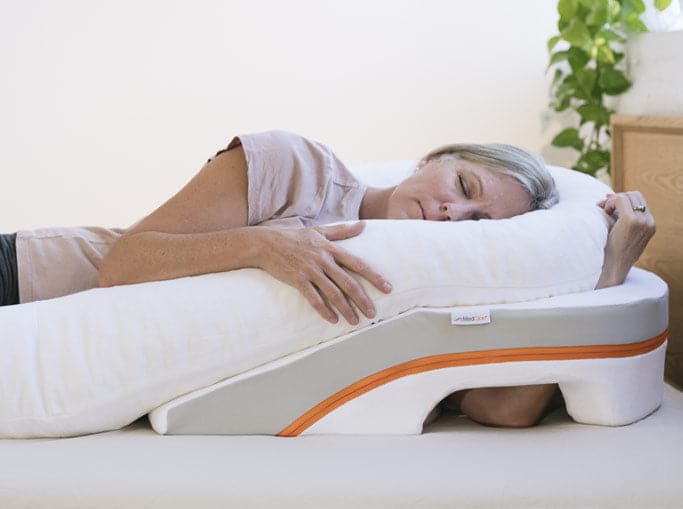
A wedge pillow is the one shape in the sleep apnea aisle that changes something physical: it raises your torso so gravity works with your airway instead of against it. It is not a treatment, and it does not replace CPAP or an oral appliance. But used correctly it can make back sleeping less punishing and it helps with the reflux that so often accompanies apnea. Used incorrectly — as a fat pillow under your head — it bends the neck and can make breathing worse. This guide covers the setup details that decide which one you get.
In this guide
Elevate the torso, not just the head
The most common mistake is propping the head. Stacking pillows or using a short wedge under the neck flexes the chin toward the chest, which narrows the airway at exactly the point you were trying to open. The elevation has to start at the hips and rise gradually through the shoulders so the spine stays in a straight line.
In practice that means a wedge long enough to reach the lower back — usually 24 to 32 inches — rather than a small triangle sized for reading in bed.
What incline to use
Most people do best somewhere between 30 and 45 degrees of upper-body elevation. Lower than that and the gravitational effect is small; steeper and you tend to slide down the bed overnight and wake with hip and lower-back complaints.
Start at the gentler end for the first week. Comfort determines whether you keep using it, and a wedge you abandon after three nights helps nobody.
Stop the nightly slide
Sliding is the reason most wedges end up in a closet. Three fixes handle nearly all of it.
- Add a knee bolster or a pillow under the knees so your legs brace instead of your heels pushing you down.
- Choose a wedge with a firm high-density base rather than soft foam that compresses into a slope.
- Use a grippy fitted sheet or a non-slip cover; slick sateen surfaces make sliding worse.
Combining a wedge with CPAP
Wedges and CPAP work together fine, but the hose route changes when you are inclined. Run the hose over the head of the bed rather than across your chest so the incline does not pull the mask sideways, and check your machine's leak-rate readout for the first few nights.
If the incline pushes a full-face mask against the pillow surface, pair the wedge with a smaller cut-out pillow on top rather than a thick standard pillow.
Realistic expectations
Expect a wedge to help with reflux quickly, with snoring sometimes, and with apnea only as a supporting measure. Track how you feel over two weeks rather than judging on one night, and keep whatever treatment your clinician prescribed running unchanged while you test.
Pillows we recommend for this
FAQ
What angle should a wedge pillow be for sleep apnea?
Roughly 30 to 45 degrees of upper-body elevation suits most people. Below that the gravitational benefit is minimal; above it, sliding and lower-back discomfort become the limiting factor.
Can I just stack pillows instead of buying a wedge?
Stacked pillows raise the head without the torso, which bends the neck and can narrow the airway. If you want the benefit, the elevation needs to start from the hips.
Will a wedge pillow stop me sleeping on my back?
Not by itself. A wedge combined with a body pillow makes rolling onto the back harder, which is why wedge-plus-body-pillow systems are popular with positional snorers.
Is a wedge pillow safe to use every night?
For most people, yes — provided the incline is comfortable and you are not waking with new hip or lower-back pain. Raise any new pain with your clinician, especially if you have a spinal condition.
Keep reading
Find the Right Pillow for Your Sleep Style
Get a tailored shortlist based on sleep position, shoulder fit, desired loft and materials using our free Pillow Finder.
Start the Free Pillow Finder →Instant recommendations, no email or signup required. We may earn commissions on some buying links.
Affiliate disclosure: Mr. Squish may earn a commission when you buy through links on this page. Recommendations are based on independent product research; any hands-on test is labelled separately. Learn more.